What happens before an artwork reaches a wall?
Before the first visitor walks through the gate, before a label is placed beside an installation, before corridors begin to look like exhibition spaces and before anyone stops in front of a piece and says, “That’s interesting,” there is a much longer story.
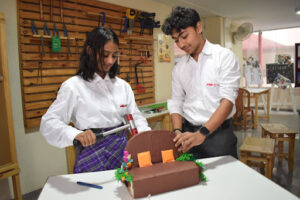
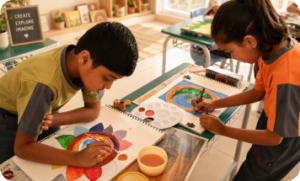
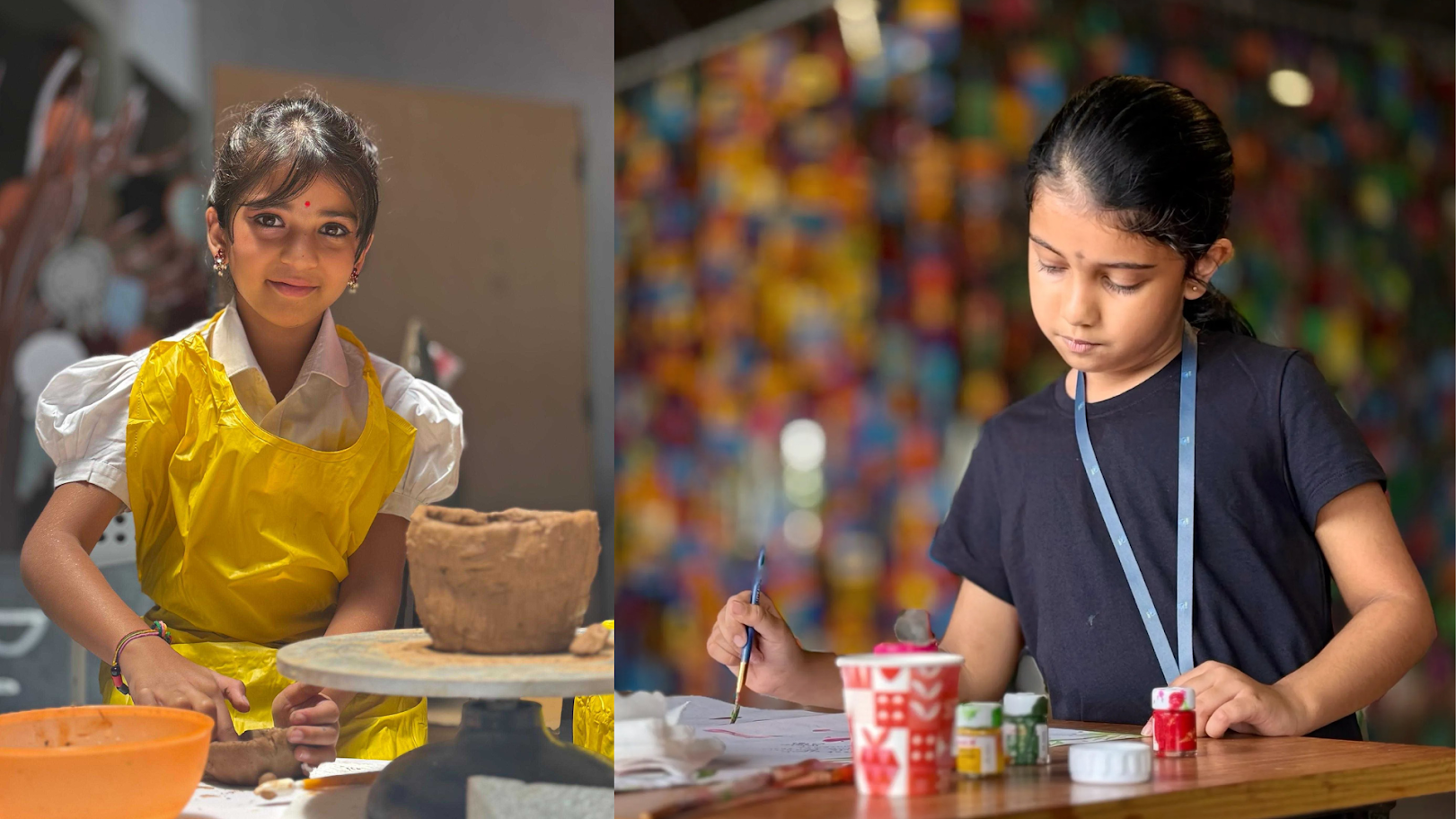
It begins in classrooms and corridors, around tables scattered with paper, clay, cardboard, paint and unfinished ideas. It begins with children talking to one another, educators asking questions instead of immediately giving answers, sketches being changed, materials being tested and an idea slowly beginning to take form.
Sometimes, it begins with a question nobody expected.
During one such conversation, a child asked why an artwork should be made digitally. The reason was simple but striking: What if there are not enough trees to make paper in the future?
Suddenly, the conversation was no longer only about art. It was about sustainability, technology, resources, preservation and the kind of future children believe they may inherit.
This is the story behind the Ekya Children’s Biennale.
Across eight campuses, the Biennale unfolded over approximately seven to eight weeks. What visitors eventually encountered as paintings, installations, digital pieces, memory boxes and collaborative artworks was only the visible end of a much deeper process of thinking, questioning, experimenting and creating.
At the centre of that process was one question:
What does the future feel like?
There was no model answer. There was no artwork displayed on a board for children to reproduce. There was no fixed interpretation of what the future was supposed to look like.
That uncertainty was intentional.
The future, after all, cannot be copied.
It has to be imagined.
The journey began with conversation, not creation
The Biennale began with a belief that children should not only learn about the world they are going to inherit. They should also be given opportunities to imagine the world they may one day help shape.
That meant looking at art differently.
Art could not be limited to drawing or painting something beautifully. It could be visual, performative, emotional, conceptual or collaborative. It could preserve a memory, question an existing idea, respond to an environmental concern or create an image of something that does not yet exist.
More importantly, art could become a way for children to make their thinking visible.
Instead of beginning with “What should we make?” campus teams began asking what children were thinking about the future. Educators, coordinators, leadership teams and students came together to explore themes that resonated with their communities. Different campuses interpreted the future through ideas such as memory, nature, culture, rituals, place and play, allowing each campus to develop its own distinct journey while remaining connected to the larger Biennale question.
The discussions quickly moved beyond the obvious.
What will people remember about us fifty or a hundred years from now? What parts of our culture should we protect? What might happen to nature? Will the materials we use today still be available in the future? How will technology affect the way we create or remember? What should change, and what should remain?
These questions were not meant to be answered in a single classroom conversation. Children returned to them, discussed them with friends and educators, challenged ideas and gradually translated abstract thoughts into something that could be seen, touched, experienced or interacted with.
Over the following weeks, conversations became sketches. Sketches became experiments. Experiments became installations. In some cases, an idea changed completely along the way.
That movement from uncertainty to creation became one of the most valuable parts of the Biennale.
When an artwork becomes personal
Some of the ideas that emerged were deeply connected to children’s own lives.
Memory, for instance, became much more meaningful when students began asking what they would actually want to carry into the future.
This thinking found expression in memory boxes filled with photographs, favourite experiences and moments children considered important.
For an adult, eight or ten years may feel like a relatively short period of time. For a child, however, those years contain almost everything they have ever known. A birthday, a family celebration, a grandparent, a friendship, a first achievement, a holiday, a favourite place or a moment when they felt proud can hold enormous significance.
By deciding what belonged inside a memory box, children were doing far more than completing an art activity. They were making choices about identity, belonging and remembrance.
They were quietly asking themselves:
What from my life matters enough that I would want to carry it forward?
In that moment, the idea of the future became inseparable from the past and the present.
The same depth could be seen in the question about paper. A material that most of us use without much thought suddenly became part of a larger environmental discussion. Perhaps art in the future would need to be stored digitally. Perhaps materials would have to be used differently. Perhaps things that seem ordinary today could become scarce tomorrow.
This is where inquiry becomes powerful. Children stop seeing a material simply for what it is and begin asking what it represents, where it comes from and what its future might be.
The artwork then becomes more than an object.
It becomes evidence of thought.
What the artists saw in the children’s work
The perspectives of the Biennale’s chief guests added another layer to this journey.
Artist and speed painter Vilas Nayak reflected on the importance of playfulness and spontaneity in the creative process. Having worked professionally as an artist for many years, he spoke about how easy it can be for adults to become focused on perfection. With experience comes the desire to refine, judge and correct. Yet in trying to make something perfect, artists can sometimes lose the freedom and instinct with which they began creating.
His own live speed-painting practice has taught him something different. A painting created rapidly on stage does not allow endless correction. It can be imperfect, but it can also feel raw, genuine and alive.
That idea connected strongly with the children’s work at the Biennale.
The intention was never to produce a collection of identical, highly polished objects that looked as though an adult had planned every detail. A line could be uneven. A form could be unexpected. An installation could change direction midway. The important thing was that the thinking remained the child’s.
Vilas also reflected on authenticity in a world where young artists have access to an extraordinary number of images, tutorials and references. A child can watch an artist in another country within seconds, learn a technique online and encounter hundreds of visual styles before ever stepping into a gallery.
This access offers enormous possibilities, but it also raises an important question: how do young people learn from others without simply copying them?
For Vilas, the answer lies in personal experience. Technique can be learned. What gives an artwork its individuality is the creator’s own story, memories, surroundings, interests and emotions. Children therefore need not only technical exposure but also the confidence to bring their own experiences into what they make.
Chief guest Raghavendra Hegde reflected on another quality children naturally bring to creativity: freedom from too many preconceptions.
Give a child crayons, clay, pastel or even a corrugated cardboard box, and the first response is often to explore what it can become. Adults tend to approach the same material with more rules. We begin thinking about measurements, proportions, methods and whether something is being done correctly.
Those questions are important when developing skill, but children’s instinctive creativity reminds us that imagination often begins before the rules.
Raghavendra spoke about how this freedom can become harder to retain as children grow older and logical, academic and practical demands begin taking over. His reflection was therefore not about choosing creativity instead of logic. It was about protecting some creative space within ourselves as we grow.
In a world increasingly focused on artificial intelligence, he described this as retaining one’s “artistic intelligence.”
Technology will continue to change. New tools will appear and today’s tools will eventually be replaced by something else. But a tool alone does not create wonder. What matters is how a person uses it, what they bring to it and what they choose to express through it.
Vilas offered a similar view of AI. Technology can assist at the conceptual stage, generate possibilities and help artists explore ideas. But what continues to give an artwork meaning is the story and experience behind the person creating it.
For children growing up alongside AI, that distinction may become increasingly important. They will need to know how to use powerful tools, but they will also need to know what they think, what they care about and why their ideas matter.
The children remained the artists
Behind every child involved in the Biennale was a much larger team.
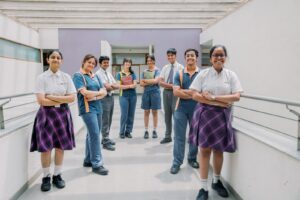
Educators facilitated discussions and introduced materials and techniques. Coordinators helped organise the process. Campus teams supported the logistics. Leadership created the space and time needed for the work to develop.
But there was one principle that remained central throughout the journey:
The work had to remain authentically the children’s.
That required adults to know when to guide and when to step away.
An educator could ask, “Why do you think this?” or “What material might help you communicate this idea?” An educator could help a child understand why a structure was not standing or introduce a new technique that might help. But the role of the adult was not to redesign the installation until it looked more polished or complete the difficult parts on the child’s behalf.
The difference matters.
When adults take over, the final product may become neater, but the child loses ownership.
The Biennale deliberately protected that ownership.
As a result, visitors encountered individual and collaborative work shaped by children’s questions, conversations, choices and imagination.
Collaboration itself became another important learning experience. Creating something together meant children had to work through different opinions. One child might imagine an installation in one way while another saw it completely differently. Groups had to listen, explain, negotiate, compromise and sometimes rethink their ideas entirely.
These moments might appear like challenges in completing a project, but they were part of the learning.
Outside school, people rarely solve meaningful problems entirely alone. We work with people who have different perspectives, communication styles and ideas. Children experienced a small version of that reality through the Biennale.
The learning therefore went beyond artistic technique. It included confidence, communication, collaboration, conflict resolution and the ability to adapt when something did not work as planned.
Making the invisible learning visible
Visitors usually encounter the finished artwork.
What they do not immediately see is everything that came before it: the first sketch, the material that failed, the structure that collapsed, the colour that did not work, the conversation that changed the direction of an idea or the moment when a group had to begin again.
These stages mattered enough that campuses documented them through learning walls.
The walls captured the materials children explored, the techniques they learned, the media they experimented with, the processes they followed and the outcomes that eventually emerged.
This was particularly important because the Biennale was happening in a school.
A finished artwork tells us what was created.
The process tells us what was learned.
The learning walls acknowledged that strong creative work rarely appears fully formed. Artists experiment. Designers prototype. Writers rewrite. Scientists test and retest. Ideas evolve.
Children needed to see that mistakes and changes in direction were not interruptions to learning. They were part of it.
Sustainability also became visible through the choice of materials. Raghavendra Hegde highlighted one collaborative artwork that used recycled materials, noting not only the collective effort behind it but also the message carried by those materials.
A discarded cardboard box, for instance, does not have to remain in packaging. In the hands of a child it can become a sculpture, a building, an imagined city, an object from the future or something that cannot easily be named.
That ability to look at something and see what else it could become is at the heart of creativity.
And it extends far beyond art.
When the school itself became a gallery
Another significant shift during the Biennale was where the art lived.
Art moved beyond the art room and became part of the everyday campus environment.
Installations appeared in corridors and shared spaces. Students encountered them during the ordinary rhythm of their school day. They could return to a piece, talk about it with friends, watch visitors respond to it and experience the campus itself as a creative space.
Vilas Nayak connected strongly with this idea because his own live-art practice is built around taking the process of art directly to people. Rather than seeing only the completed work inside a gallery, his audience watches the painting being created.
The Biennale offered children something similar.
The process was not hidden.
Their questions, experiments and learning became part of what the audience encountered.
This is also why the role of visitors matters.
A children’s Biennale is not simply an opportunity to come and see colourful work displayed around a school. It offers adults a rare opportunity to encounter children’s thinking about the future.
What are children worried about?
What do they want to preserve?
What do they find beautiful?
What do they believe should change?
What possibilities can they imagine that adults may have stopped noticing?
Both chief guests reflected on the value of experiencing the work in person and encouraging the next generation of creators. Their observations point towards something larger: when adults take children’s work seriously, they are also telling children that their thoughts are worth listening to.
What remains after the installations come down?
Eventually, every exhibition ends.
Installations are dismantled. Materials are moved. Corridors return to their familiar form.
But perhaps the success of a Biennale cannot be measured only by what remains on the walls.
It can also be measured by what remains in the child.
Perhaps a student becomes less afraid to share an unusual idea. Perhaps a group learns that disagreement does not have to prevent collaboration. Perhaps an educator discovers a different way of facilitating an art experience. Perhaps a parent looks at a child’s creation and asks “Tell me about this” before asking “What is it?”
Perhaps a memory box helps a child realise that their personal experiences deserve to be valued.
Perhaps a question about paper changes the way someone thinks about resources.
Perhaps a young artist remembers Vilas Nayak’s reflections on playfulness and learns not to judge every imperfect attempt too quickly.
Perhaps another child remembers Raghavendra Hegde’s idea of artistic intelligence and continues protecting that creative part of themselves even as they grow older.
If those things remain, the Biennale continues long after the physical exhibition has ended.
Across eight campuses, children were invited to imagine something none of us can see completely: the future.
They approached it through memory, nature, culture, technology, place, play, materials and stories. They looked backwards to understand what might be worth preserving, looked around at the world as it exists today and then looked forward to ask what could come next.
What visitors see is the visible outcome of that journey.
But the real story lies behind the installations.
It lies in seven or eight weeks of conversations, in ideas that changed, in experiments that failed, in groups that found a way to work together, in educators who guided without taking over and in children who discovered that something once existing only in their imagination could become real.
And perhaps the most important moment comes when a child stands in front of that creation and can say:
“We made this.”
That is what makes the Ekya Children’s Biennale more than an art exhibition.
It is a celebration of curiosity, imagination, collaboration and creative courage. It reminds us that children do not need adults to define the future for them. They need opportunities to question it, imagine it and begin shaping their own responses to it.
Behind every installation is a child telling us something about the world they hope to inherit.
Our role is to look closely, ask what they were thinking, and listen.
The Biennale is not limited to its inauguration weekends. The experience continues every Saturday until 31 October, giving families and visitors more opportunities to step into the campuses, explore the installations at their own pace and engage with the ideas children have created around the future. Each visit becomes a chance to look beyond the finished artwork and discover the questions, stories and thinking behind it.