Inside a journey where students question, create, test and build, supported by Mentors, Coaches and Judges along the way.
It Begins with “What If?”
It Begins with an Idea
That is where the Young Founders Challenge (YFC) begins. An idea may start small, but through exploration, testing, feedback and rebuilding, students learn how to turn it into something real.
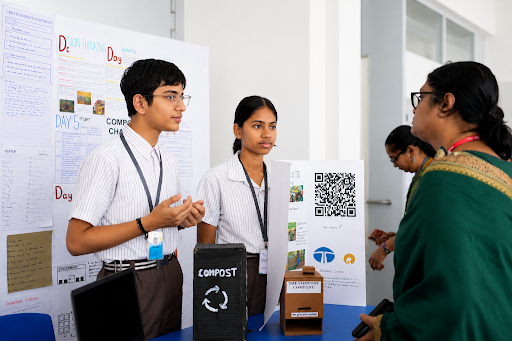
An initiative by CMRNPUC and Ekya Schools, YFC brings together nearly 2,000 students from Grades 8 to 12. Over the course of the program, students move step by step from identifying a problem and shaping an idea to building and refining a working product.
And they do not make this journey alone. Mentors, Coaches and Judges with real-world experience guide students at different stages. They ask questions, share perspectives, challenge assumptions and offer constructive feedback. Each plays a different role, but together, they help students think more deeply, make better decisions and keep moving their ideas forward.
Four Ways to Make a Difference
The program has four roles. Each role has a name, a job, and a time commitment. Let’s look at each one.
- Mentor – Guide a team forward (~4 hours total)
A mentor stays with a few teams for the whole program. They check in regularly. They help students think clearly, make good choices and keep moving when things get hard. A mentor is a great fit for someone who has built or run a business.
- Product Coach – Shape the idea into reality (6–8 flexible hours)
Product coaches work with teams on the product itself. They help from the first spark of an idea all the way to a working prototype. This role is perfect for people with a background in product, design, or engineering. The hours are flexible.
- Venture Coach – Build the business brain (6–8 flexible hours)
Venture coaches help teams think through the business side. How big is the market? How will the team make money? What should the price be? How will it grow? This role is perfect for people from sales, strategy, finance, or business development. It also takes 6 to 8 flexible hours.
- Jury Member – Spot the real potential (3–4 hours total)
Judges come in at key evaluation points. They listen to pitches. They ask the hard questions. They give an honest outside opinion on what is working and what is not. It takes only about 3 to 4 hours in total but those hours can change how a young team sees its own idea.
Notice something nice here. None of these roles ask for a full-time commitment. Even a busy founder can spare a few hours to change a young student’s life.
What the Mentors Taught
This year, students got to learn directly from people who have really built things. Here is what each one shared.
Kaushik Mudda – start before you feel ready.
Kaushik Mudda is the Co-Founder and CEO of Ethereal Machines. He spoke to more than 1,500 students. His own story is the lesson: he started with rough sketches, and today his precision machines are used in factories around the world. His message to students was simple: you don’t need to know everything to begin. You just need the courage to explore, learn, and keep building. His favourite idea: You don’t fail – you find out.
Ratul Narain – care about the problem first.
Ratul Narain is the founder of BEMPU Health. He led a masterclass called “From Idea to Impact: Building Solutions That Matter.” He taught students that ideas don’t become great overnight. They grow slowly, step by step. First, you must really understand the problem. You must care about the people facing it. Only then can you build, test, and improve something that truly works. For 1,500+ students, the answer began with empathy: understanding the problem before trying to solve it.
Akhil Iyer and Shriya Narayan – what makes a brand memorable.
Akhil Iyer and Shriya Narayan are the founders of Benne. They talked to students about brands. Their question was: what makes people genuinely care about a brand? The answer, they said, is not just marketing. A great brand tells a real story. It builds something people truly connect with. It was a conversation that went beyond business.
What the Judges Do
Mentors walk with the teams. Judges wait at the checkpoints.
At key moments in the program, the judges listen to each team’s pitch. Then they ask the hard questions: Is this a real problem? Who is it for? Why will it work? What is not working yet?
This might sound scary. But it is actually a gift. Real founders face these questions all the time from customers, from investors, from the market. Getting them early, while there is still time to fix things, helps students build stronger products. Their job is not to be nice, it is to be honest.
What Students Have Already Built
The program is working. Students are not just learning, they are building.
A smart streetlight sensor. One team noticed a problem their whole city quietly lives with: streetlights stay on all night, even when nobody is around. Most people notice this and forget about it. This team decided to do something. Using Arduino, they wired up a smart sensor on a breadboard. They built the physical mount by hand in the workshop. Their first try did not fully work so they went back, found what was missing, and kept refining until it did. That persistence is the whole point.
A 3D-printed medicine device. Another team started with something they noticed at home: older family members struggling to manage their daily medicines. They treated it as a problem worth solving. They sketched the idea by hand. Then they turned the sketch into a precise 3D model on the computer, sized carefully for real use. Then they printed it in the maker space. What they ended up with is not a classroom model. It is a real, working device, built to make a real person’s day a little easier.
Both teams learned the same lesson every founder learns: the first version is never the final one. Building for real people means testing, adjusting, and getting the details right.
Why This Matters
The Young Founders Challenge is a simple bet: if you give young people a safe place to try, fail, learn, and try again with experienced builders beside them, they will build amazing things.
The mentors teach them to start. The coaches teach them to build. The judges teach them to be honest with themselves. And the students? They learn the most important lesson of all: stop waiting for everything to be perfect. Just start building.